
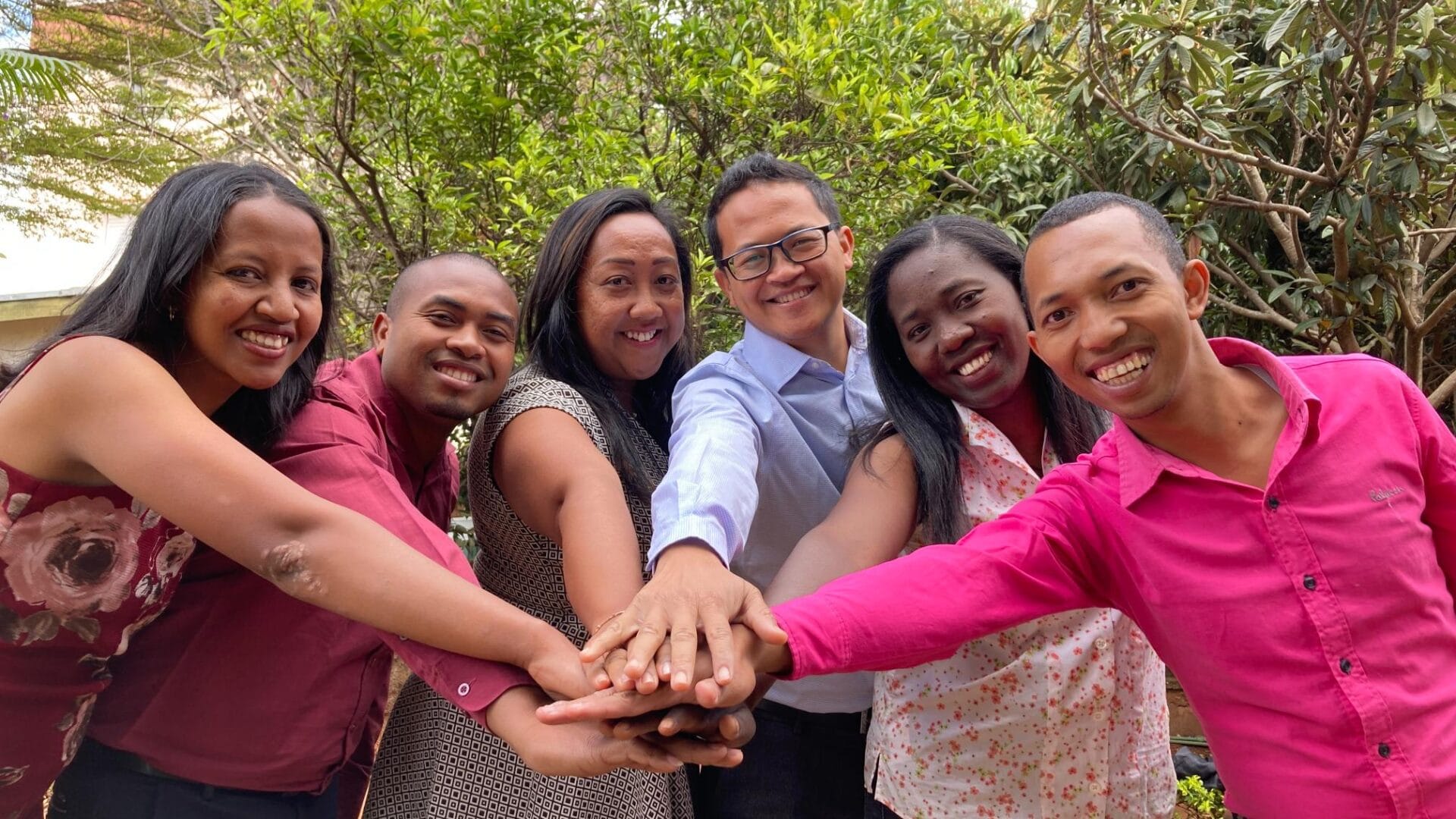
When you hear the name AiNA soa, you probably picture our trainers performing cardiopulmonary resuscitation, a room full of participants, mannequins, bandages and first aid kits. That is indeed our mission: teaching everyone the actions that protect, alert and save lives.
Today, I invite you to discover what is seen less often: everything that happens before and after a training. What takes place in the classroom is only the visible part of the story. Long before the first demonstration, a whole team is already hard at work. Come with me behind the scenes of a first aid training preparation, and meet the people who make each mission possible.
1. It all starts with the equipment: Mamitiana’s meticulous work
Once the training is confirmed, preparations begin, starting with the equipment. And if there is one person whose work deserves to be highlighted, it is Mamitiana.
Behind those clean, neatly folded and well-stored bandages, there is time, energy and a great deal of patience. Mamitiana washes them, scrubs them with a brush when needed, bleaches them, dries them, irons them, then stores them carefully. She does not say much, but she is constantly at work, and I am always impressed by her determination.
Some days are particularly heavy: long hours spent standing, washing, ironing and folding, one by one, all those small pieces of cloth. Yet thanks to this steady work, we have never run out of ready-to-use equipment.
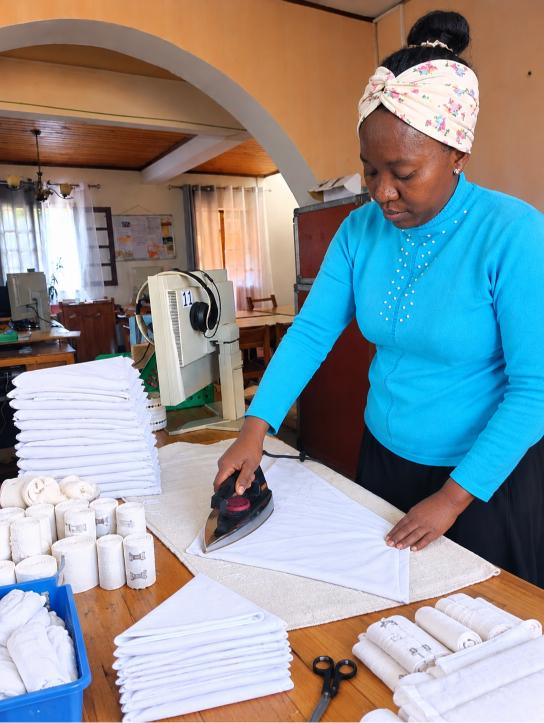
Participants do not necessarily know who washed their bandages or cleaned the mats and bags. They simply find clean equipment, ready to use.
Discreet work can have a considerable impact: a quality training also starts with carefully prepared equipment.
2. Planning every detail: the role of the administrative team
Meanwhile, another job takes place at the office: organising the mission. This is where Daniella and Mirana come in.
A training schedule looks simple: set a date, book a room, inform the participants. In reality, almost everything has to be considered: departure and return dates, road conditions and weather, the people to meet on site, the number of participants and their contact details, the availability of the venue, accommodation, communication around the event, and the confirmations needed before departure.
A missing piece of information or an unconfirmed booking can disrupt the whole mission. Daniella and Mirana therefore make sure everything is clear, consistent and validated, so that the team knows where to go, when to leave, whom to contact and what awaits them on site.
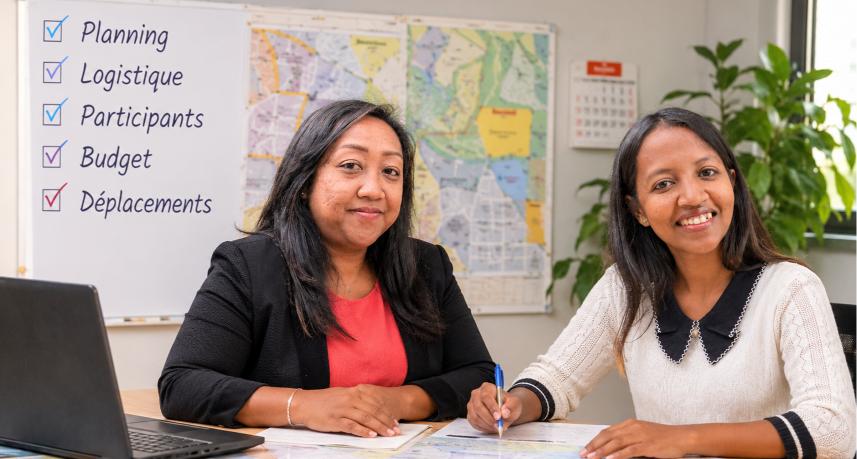
A big thank you to these two colleagues for their attention to detail.
3. Planning the budget: every detail counts
A training that involves several people travelling long distances brings very real expenses. This is where I step in: based on the schedule and the needs identified by the team, I prepare the mission budget.
This means estimating mileage and fuel, meals, accommodation, communication costs, equipment, and the bookings and deposits to be paid in advance, not forgetting a small reserve for the unexpected.
The goal is not to fill a spreadsheet with figures, but to make sure the mission takes place under good conditions, that the trainers have what they need, and that expenses stay within the planned budget.
4. Preparing the kits and materials: nothing must be missing
As the day of the training approaches, Avotra takes over. Starting from the “Training Equipment Request” drawn up by the trainers, he gathers the equipment, checks its condition one item at a time and consults the inventory to spot anything that might be missing: teaching materials, mannequins, bags, mats, bandages, first aid kits and accessories for the demonstrations.
Thanks to these checks, the trainers can focus on what matters most: sharing their knowledge and guiding participants through practice.
5. Logistics and equipment: Eddy’s work
A training does not rely only on bandages and mannequins. Depending on the programme and the conditions on site, other equipment is essential, and it is Eddy, our IT manager, who makes sure it is available: projector, speakers and microphones, phones, cameras, computer, cables, chargers, batteries and, when necessary, a generator.
Having it all is not enough. Eddy checks that everything works, that the accessories are available and, if needed, runs a hands-on session so that the whole team knows how to use it.
6. Preparing the vehicle and ensuring safety: a step not to be overlooked
To reach our partners, we have to cover several hundred kilometres. We are currently working in the Menabe region, about 700 kilometres from the city centre. The journey can take ten hours, or even longer depending on the state of the national roads and unforeseen events. Before even thinking about the training, we therefore have to make sure the vehicle is in perfect condition.
This is the work of Ranto, our new fleet manager. Our faithful companion on long journeys, the 2012 Mazda BT-50 acquired in 2016, has already covered more than 103,600 kilometres and still takes us everywhere without any major problem.
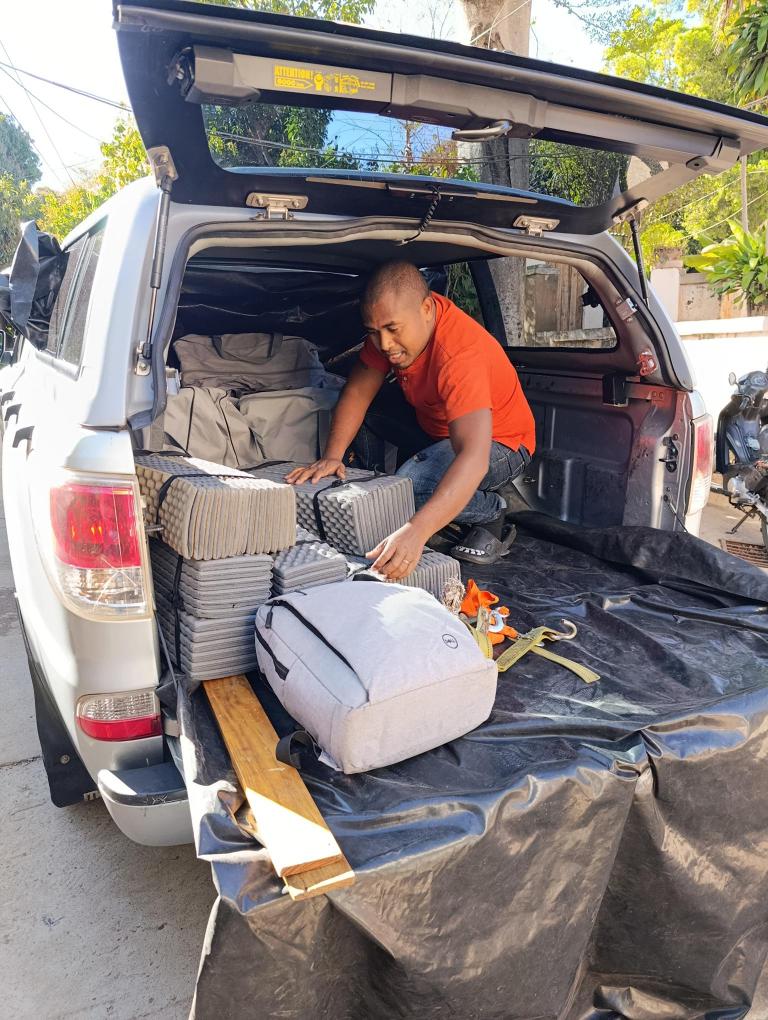
Before each departure, Ranto checks routine maintenance (oil change, filters), the condition of the tyres and belts, the brake pads, the silent blocks, the front and rear axles, as well as fluid levels. He fixes minor issues himself and calls in a garage when the problem is more complex.
He then makes sure there is enough fuel for the trip. Next comes a simpler step, one I particularly enjoy: washing the vehicle, because it is always pleasant to hit the road in a clean car. Finally, the training equipment is loaded into the back of the pick-up, neatly arranged and secured for transport.
Arriving safely at our destination is already a first success for the mission.
7. The briefing: the last step before departure
It is time to bring the pieces of the puzzle together: bookings, communication, schedule, logistics and budget. The team meets for a briefing, an essential step so that everyone knows what to expect in the field.
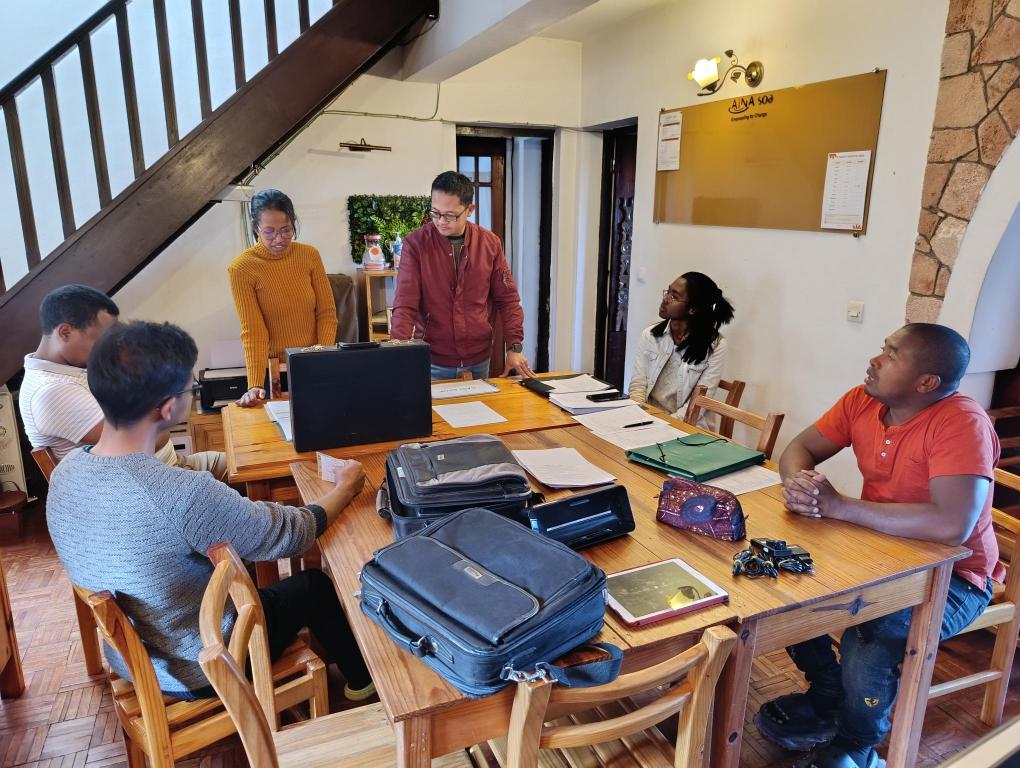
Mirana presents the arrangements made, the contacts established and the important information. For my part, I present the financial side: expenses already paid, those still to be paid and the costs expected on site. I then hand over the funds to the person designated to manage expenses during the mission, along with the information needed to track the budget and prepare the financial report on return.
This moment lets everyone ask questions, clarify the last points and check that everyone has the same information.
When everyone knows their role, the team can hit the road with peace of mind.
8. In the field: the unexpected is part of the mission
Even when everything has been carefully prepared, the field holds surprises: a room still occupied when we arrive, a venue changed at the last minute, an unsuitable room, participants given different information from what we communicated, far fewer attendees than expected, a venue manager who cannot be reached, or even a hotel room that was booked but is no longer available.
There can then be fatigue, disappointment and sometimes discouragement: after all the work done beforehand, it is not easy to rethink plans at the last moment. But with experience, we learn that the unexpected is part of the field. We cannot control everything, but we can react better, help one another and look for solutions. It is in these moments that team spirit takes on its full meaning: everyone lends a hand and we focus on what matters most.
9. Back home, the story continues
A training often ends with goodbyes, group photos and packing up the equipment. One might think the story stops there, but an important step remains: follow-up.
Back at the office, the trainers write their reports and pass the information gathered to Mirindra, who summarises and records it carefully. Each participant is assessed to determine whether they meet the requirements to receive a certificate. Mirana then prepares and prints the certificates, and I make sure they are handed over to their owners.
Behind every training, one shared goal
A first aid training is the result of genuine teamwork. Everyone has their own responsibilities and expertise: some work directly with participants, others mainly before departure or after the return. Some tasks are visible, others go almost unnoticed, but all contribute to the success of the mission.
Behind every training, there is a whole team. And behind that team, one shared conviction: every life counts.
Want to join us? AiNA soa runs thanks to volunteers and to the support of those who believe in our mission. You can help by making a donation, which contributes to financing our travel, our equipment and our trainings, or by joining our team as a volunteer. Contact us to find out more, and share this article to help spread the word about our work. Every skill learned can save a life.
Jimmy, HR & Accountant